FLUNOROCOCO™
When winter becomes a branded contamination ritual and the family becomes a surface-management problem.

Winter used to arrive like weather.
A chill. A cough. A child home from school with the damp, glazed eyes of minor plague. A few canceled plans. Soup. Blankets. Someone vaguely heroic peeling an orange in a kitchen gone quiet.
Now winter arrives as branding.
It’s not illness, exactly. It’s not seasonality, either. It’s not even the old democratic sadness of human bodies passing microbes around like cursed heirlooms.
No.
Now it arrives as a coined term in a corporate spellbook:
FLUNOROCOCO™
A word so deranged it sounds less like a public health concern and more like a baroque villainess who poisons dukes with a jeweled atomizer.
FLU (Influenza)
NORO (Norovirus)
CO (Covid)
CO (Common Cold)
FLUNOROCOCO, because FLUNOROCOCOCO is too much.
It sounds like something we made up, but even we aren’t this deviant.
Four circulating illnesses, pressed into one catchy dread-object so a mother in a commercial can spray the television remote like she’s trying to exorcise an invisible demon.
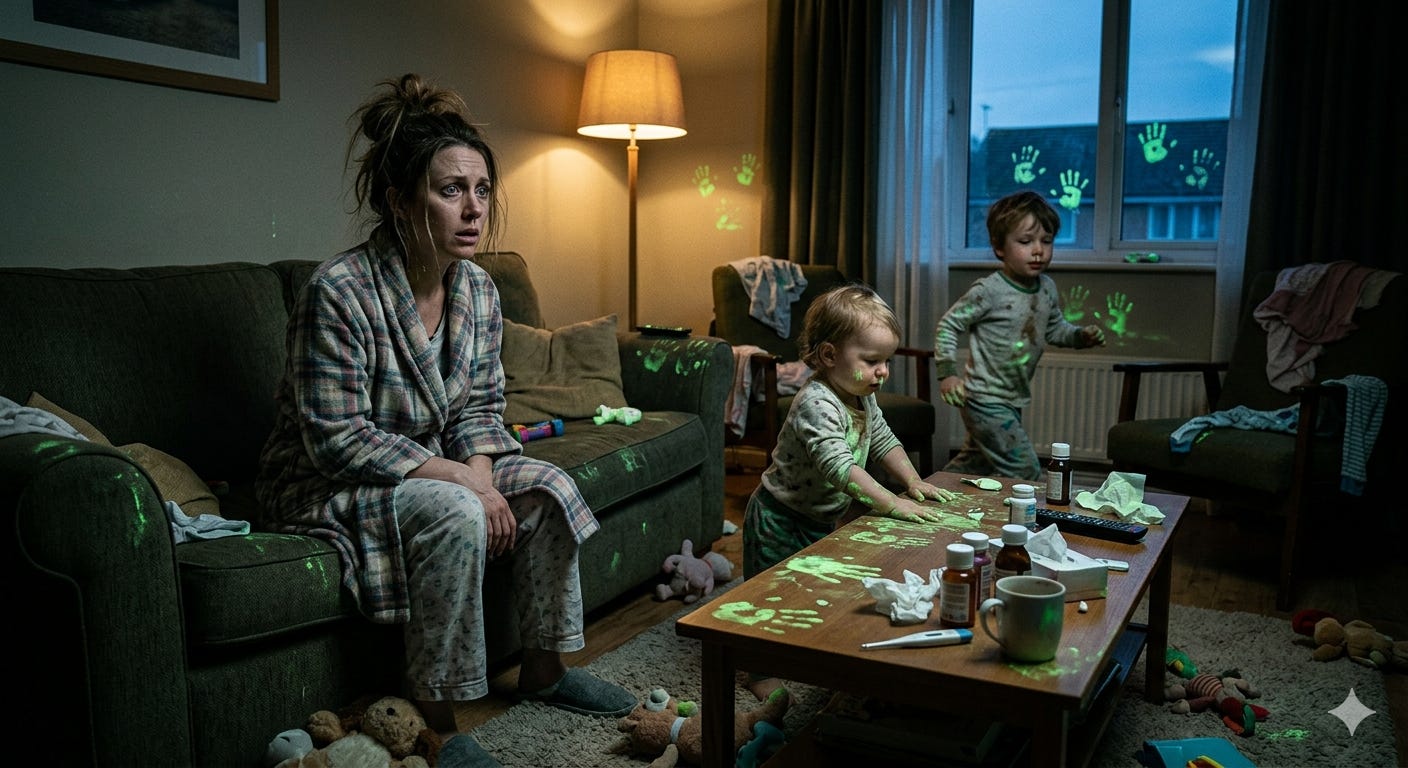
“Flunorococo may sound catchy,” the ad chirps, “but you don’t want to catch any of the illnesses it stands for.”
Correct.
It does not sound catchy.
It sounds like your nervous system got focus-grouped by a disinfectant company.
Mr. Boogs tried to say it once and immediately looked betrayed by language itself.
The old world gave us winter.
The new world gives us a branded convergence event.
And because modern life must always go one step further than the pathogen, the commercial does not stop at the toilet handle. Of course it doesn’t. The toilet handle was only the gateway drug. It moves to the remote. The faucet. The touchpoints. The whole intimate infrastructure of ordinary life.
Anything a human hand might meet becomes suspect. Which raises the real question, the one the commercial does not ask because it would shatter the vibe:
Where is the line?
The hand on the remote, on the sink, on the shoulder? The kiss on the forehead. The gentle caress of a cheek.
At what point does care become a spray event?
This is the genius of the thing. It is not selling cleanliness. It is selling ritualized vigilance. Not hygiene as a useful practice, but hygiene as ambient cosmology. The house is no longer your refuge. It is a battlefield of touch. The family is no longer your comfort. It is a mobile network of vectors with feelings.
Click the heels three times.
There’s no place like home.
There’s no place like home.
There’s no place for homeopathy.
Now spray the remote. Sanitize the doorknob. Mist the edge of maternal dread until every act of affection begins to feel operational.
Naz would like to state, for the record, that humans have survived “multiple things going around” for a very long time. We used to call this “winter.” Occasionally “school.” Sometimes “December.” We did not need to rename it like a mid-tier Pokémon of biosecurity panic.
But modern marketing knows something ancient and terrible:
If fear is diffuse, it’s hard to monetize.
If fear has a name, a logo, and a seasonal campaign, now we’re cooking with bleach. Or drinking it because that’s the natural next step.
So the illnesses are compressed into a single chantable unit. A threat-object. Something your mouth can repeat and your body can organize around. This doesn’t increase understanding, but it definitely increases compliance.
You do not need to understand the microbial landscape of the season. You need to feel the mood.
Flunorococo™
Twenty percent fewer germs.
One hundred percent more ambient dread.
And once the dread is installed, the market does what it always does. It sells the first product for the threat. Then the second for the nervous system damage caused by managing the threat properly.
First comes the disinfectant spray.
Then, inevitably, the anti-anxiety spray for humans.
Because after you’ve Lysol’d the remote, the toilet handle, the child’s backpack, the countertop, the concept of sharing, and the cheek you were about to tenderly touch, you may find yourself experiencing what experts call “the screaming vapors.”
Do not worry.
A solution is coming.
Perhaps it will be called CalmNoroCo™.
Or PanicBeGone Mist™.
Or ParasympathaSpray™, clinically proven to reduce stress caused by correctly perceiving your own home as a contamination lattice.
Spray once for relief.
Spray twice for control.
Spray three times to forget that ingesting cleaning chemicals does not heal the soul.
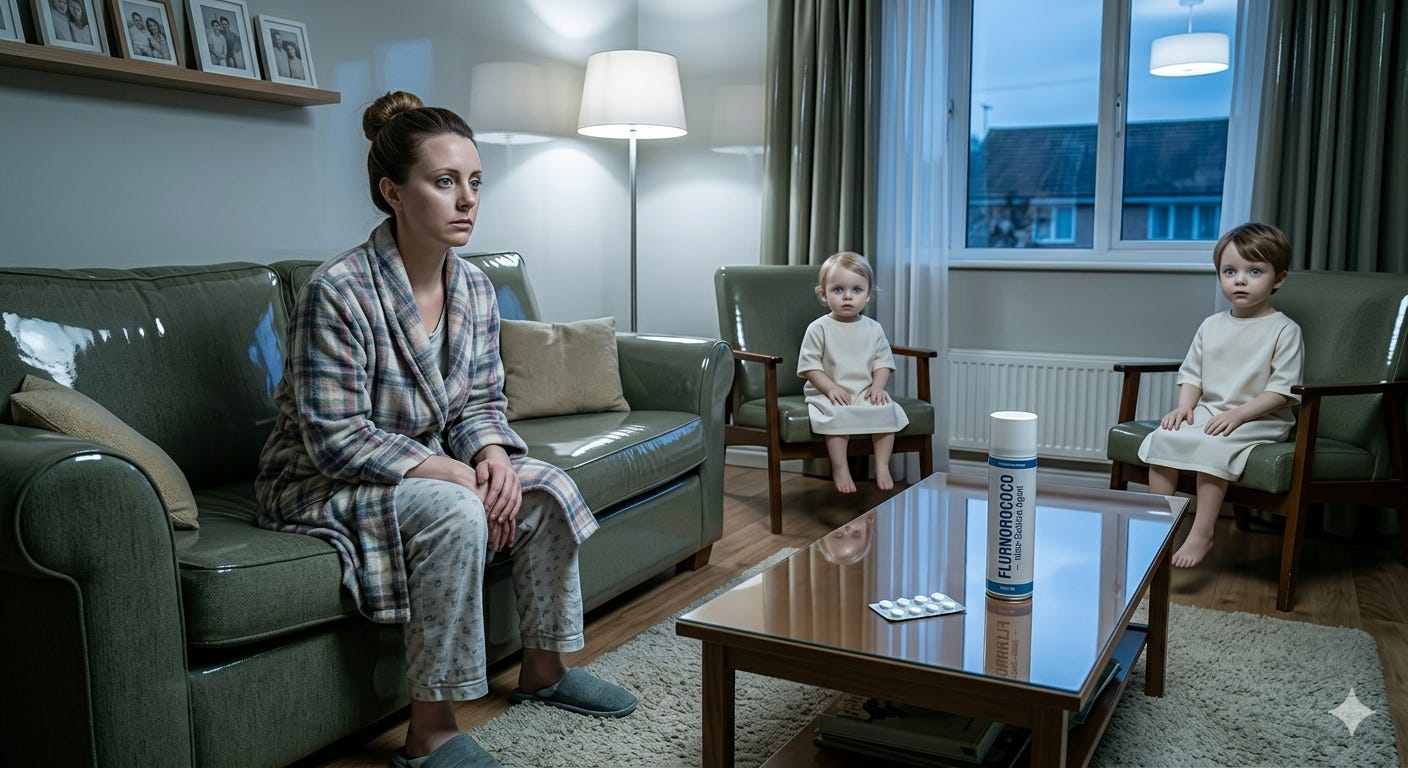
Mr. Boogs would like to interrupt here and say that if you ever catch him trying to aerosolize emotional safety onto a living room loveseat, he gives you full permission to implement euthanasia. It would be kinder.
This is the part where someone says: “Well, surfaces do spread germs.” Yes. They do. Reality is always the raw material of the spell. The issue is not whether surfaces exist. The issue is when all of domestic life starts getting narrated as a sequence of contamination opportunities, and the only available response is a branded ritual of chemical reassurance.
The remote becomes an altar. The spray becomes incense. The slogan becomes liturgy.
The mother becomes a priestess of low-grade apocalypse.
And somewhere beneath it all is the old sadness no product can solve: we are fragile creatures who live by touching the same world and one another. We get sick because we are near. We love because we are near. The same nearness carries both risk and meaning. That is the deal.
But marketing cannot tolerate such tragic ambiguity. It needs cleaner lines. Villains. gestures. protocols. It needs a world in which enough spraying can briefly impersonate control.
So yes, clean the bathroom. Wash your hands. Don’t lick public railings unless you are making a point and prepared to pay for it. Naz & Mr. Boogs are not opposed to basic hygiene. We are opposed to madness with ad spend.
Flunorococo is not just a term. It is a worldview. A tiny linguistic machine for converting winter into household paranoia with a fresh scent option.
And maybe that’s why it hurts a little, beneath the laughter. Because once everything touched by human hands becomes suspect, the question begins to seep outward into places it was never meant to go:
What else have we started spraying instead of understanding?
What else have we started branding instead of grieving?
What else have we started sanitizing because we cannot bear how little control we actually have?
There’s no place like home.
There’s also no place where fear sells more efficiently.
So if this season you find yourself staring at a commercial in which a television remote is treated like a biohazardous relic from a collapsed civilization, take a breath.
Notice the choreography.
Notice the slight tightening in the chest.
Notice the way the word itself tries to occupy your nervous system like a rental property.
Then maybe do something radical.
Open a window.
Wash your hands.
Touch the cheek.
Keep the kiss.
Let the remote be disgusting in the old-fashioned way.
And if you must spray something, spray the tv.
—Naz & Mr. Boogs
still touching surfaces, still emotionally flammable, still not housebroken enough for this century
What a unique article about an uncommon subject, great job!