Edge Case Kevin
How ordinary life became premium training data

Kevin used to deliver burritos.
Then the second app appeared.
Not instead of the first one. Nothing vanishes that cleanly. The old world just accumulates logins, each one promising efficiency, flexibility, and a new method for dissolving the line between survival and humiliation. This one was called Context, which Kevin disliked on sight. Nobody names a thing Context unless they mean to do something faintly indecent with reality and charge by the task.
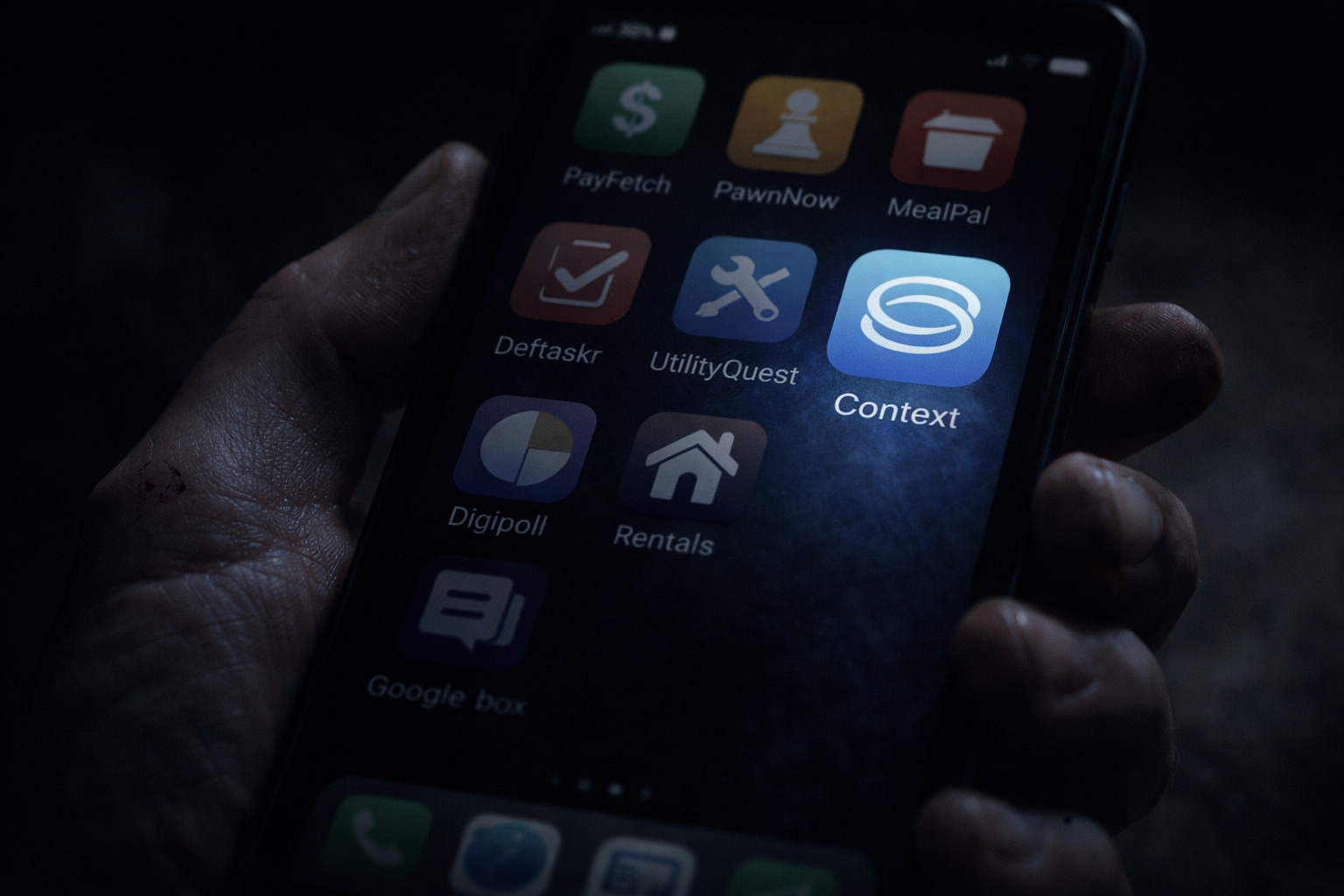
At first, the jobs were simple.
Film a sink from three angles.
Open a refrigerator and narrate what you see.
Walk down an apartment hallway and describe anything that feels unclear.
Say, in a calm voice, “I can’t find the entrance.”
Now say it again, but mildly annoyed.
Ten dollars here. Six there. Fifteen if the lighting was poor.
Kevin did not think about it much. Thinking is a luxury item, like dental work. His check-engine light had been on for three weeks with the patient moral authority of a disappointed priest. His daughter needed new cleats. The fridge at home made a clicking noise every forty minutes that sounded deliberate. The jobs paid better than lunch deliveries, especially after dark, when the app began surfacing what it called high-context opportunities.
The phrase sat badly with him, though not badly enough to close the app.
One Tuesday evening he stood outside a locked side gate at an apartment complex in Mesa and recorded himself trying the wrong keypad, squinting at faded numbers, backing up, trying again, then exhaling in what the prompt had called a “natural register of mild, cooperative confusion.” He submitted the clip. Twenty seconds later the app congratulated him.
Thank you, Kevin! Your authentic situational contribution helps improve next-generation embodied reasoning.
He stared at the screen.
Luis, who was in the passenger seat eating gas station peanuts and shedding salt onto the upholstery like a man salting a road, glanced over.
“What’d it say?”
Kevin held up the phone.
Luis read it once and shrugged.
“You look embodied,” he said. “Little heavy on the reasoning, maybe.”
That first week, Context remained almost innocent. It wanted groceries placed into trunks. Doors opened one-handed. Street noise recorded near intersections. The camera held still while Kevin approached houses with security doors, screen doors, storm doors, side doors, doors with signs taped to them in family handwriting, doors that looked as though they had already been disappointed too often by strangers.
The app paid extra when something got in the way.
If signage contradicted itself, the rate ticked upward. If a dog barked from somewhere unseen, there was a bonus. If the path was blocked by a tricycle, an Amazon box, or a potted plant placed with hostile ambiguity, Kevin earned a little more. It did not take him long to notice that confusion paid better than clarity.
Reality, it turned out, had a premium tier.
By the second week, the jobs had acquired mood.
Assemble a small shelf while narrating hesitation.
Document a minor frustration involving misplaced keys.
Record the experience of carrying two full bags while opening a door.
Describe, in your natural voice, the feeling of discovering that a beverage has spilled in transit.
The app used the word authentic so often it began to feel invasive.
One Thursday night Kevin stood in his kitchen filming himself fail to open a sticky cabinet for eleven dollars and fifty cents. Halfway through the second take, he had the brief and unwelcome sensation that history had slipped quietly off the rails and left him here, in bad light, narrating irritation for a machine that did not yet understand cupboards.
The first submission came back rejected.
Insufficiently natural. Please resubmit with more environmental ambiguity.
He looked around the room. Cheap cabinets. Unfinished groceries. A dish towel hanging from the oven handle with the defeated posture of something that had seen too much. From the living room came the soft scratch-and-shift sounds of Boogs settling into a new position of canine disapproval.
Environmental ambiguity, apparently, was all around him.
So Kevin tried again.
That was when he began to understand that the system did not want reality exactly. It wanted processed reality. The shape of genuine confusion, but legible. The contour of frustration, but not too much. Human difficulty, trimmed for model consumption. It wanted life, but with the mess edited down to useful dimensions.
That sounded familiar.
A month later, Context upgraded him.
Congratulations, Kevin! Your behavioral fidelity scores place you in the top 8% of local contributors.
Gold Tier unlocked.
Gold Tier jobs paid enough to rearrange a week.
Explain to a nonresponsive customer why the order cannot be left at the gate.
Record your verbal response to finding the elevator out of service.
Document a moment of mild caregiving complexity involving groceries, doors, and another person.
Narrate the process of calming yourself after a routine inconvenience.
He sat with that last one for a while.
Calming yourself after a routine inconvenience.
Twenty-eight dollars.
He accepted.
In the Walgreens parking lot, with the engine idling and a shopping cart drifting loose in the lot like minor social commentary, Kevin recorded himself describing disappointment in a level tone while modeling recovery. The app later praised his “excellent emotional regulation arc.”
That phrase bothered him more than the money pleased him.
He had begun, without noticing the moment it happened, to lease out portions of his own adjustment.
There were forums, of course. The internet never meets a degrading microeconomy without building a message board around it. Gold Tier workers compared tips, rates, and rejection reasons.
Do not overplay frustration.
Understate first, then add one visible sigh.
Pets improve emotional texture.
Doorway confusion is hot right now.
Background clutter helps, but not too much. The model flags cinematic mess.
One man in Nevada claimed he made three hundred dollars in a weekend using a split-level house with what he called naturally adversarial cabinetry. Another rented his grandmother’s kitchen by the hour because Context consistently scored it high for legacy-environment reasoning.
Kevin laughed at that.
Then he stopped.
Because three days earlier the app had offered him forty-two dollars to record his aunt’s apartment while narrating the challenges of navigating “compact eldercare-adjacent storage arrangements.”
He had closed the task immediately.
Then reopened it to see if it was still there.
That was the moment something turned.
Not in the app. In him.
This is what the future does when it stops arriving as spectacle and starts arriving as payment. It teaches you to see your own life in gradients of marketable difficulty. A narrow staircase is no longer just a narrow staircase. It is a high-value navigation scenario. A family language becomes premium audio diversity. Bad lighting becomes an asset. A barking dog becomes texture. The cheapness of your cabinets, the confusion at your gate, the tiredness in your voice after nine p.m. begin to shimmer with extractable value.
At the laundromat, Kevin watched a man balance a toddler, a bottle of detergent, and a phone call while using his elbow to close a dryer. Without meaning to, he thought: thirty-five, maybe forty.
The thought made him feel unclean.
At his sister’s apartment, he noticed the broken exterior light and the cracked tile by the entryway that made visitors hesitate before stepping forward. Premium ambiguity. He hated himself a little for having the phrase ready.
The high-paying tasks became harder to describe.
“What’d you do today?” his ex asked one night over the phone.
“Some deliveries,” Kevin said.
That was true, in the impoverished way many truths are now true. He had made three deliveries. He had also submitted a sequence called Threshold Friction Package 2, documented a beverage spill with moderated distress, and earned a bonus for a clip in which he approached the wrong building with what the app described as “strong recoverable uncertainty.”
Boogs watched him from the kitchen doorway while he reviewed the clips. Not watching, exactly. More like waiting for Kevin to recognize what he was doing.
The dog had started reacting to the phone before Kevin did. A low growl when the notification tone went off. A bark when Kevin angled the camera too slowly around a room. Once, when a prompt asked for “authentic domestic incompletion,” Boogs walked over to the charging strip by the wall and chewed through the corner of the power board with such focused contempt that Kevin had to pull him away by the harness.
A protest, clearly.
Or sabotage.
Or both.
Then winter came, and with it Platinum tasks.
Invitation only. Higher rates. Tighter confidentiality. The app began referring to strategic partners. The prompts got stranger. Not theatrical strange. Worse. Administrative strange. The sort of strange that arrives already normalized by interface design.
Record a genuine conversation in which one party is disappointed but attempting to remain polite.
Capture a caregiving routine involving reassurance and physical coordination.
Document a moment of domestic conflict resolution if naturally occurring.
If naturally occurring.
That phrase told the truth by accident.
The machine had developed a taste for the soft tissues of life.
Kevin declined the conflict prompt so quickly he nearly dropped the phone. Then he sat in the dark of the car and waited for himself to feel proud.
Instead, he found himself wondering what it paid.
That was the corruption. Not that the market wanted weird things. Markets always do, given time and adequate software. The corruption was subtler. He had begun to think in its categories. To look at a mess, an argument, a stumble, a tender moment, a private strain, and feel some quiet internal mechanism trying to price it.
Useful. Authentic. High-context. Premium.
One rainy Thursday the app sent a new task.
Capture authentic reassurance during moment of visible confusion. Ideal environments: medical waiting areas, school offices, service counters, transportation hubs.
Payout surged to $96.
Kevin read it once. Then again.
Something in him finally recoiled.
Not enough to quit. Not enough for the kind of clean moral drama people like to imagine about themselves. He still had bills. The check-engine light had not found God. His daughter still needed cleats. But recoil is not nothing. Recoil is a nerve proving it has not died yet.
He put the phone face down on the passenger seat and drove for a while without opening the app.
At a red light he imagined the people who wrote those prompts. Their internal decks. Their soft clean language. Human-centered. Grounded. Real-world adaptive systems. Rich contextual intelligence. He imagined some founder, somewhere, saying that nuance was the next frontier.
Then he imagined the actual frontier.
Not chrome. Not freedom. Not the clean replacement story sold onstage beneath theatrical light. Just men and women drifting through the ordinary wreckage of life with cameras in their pockets, selling the machine finer and finer slices of uncertainty, fatigue, tenderness, frustration, and care. Not because they were fooled. Because rent was due. Because hunger is persuasive. Because a market that has already bought your labor will eventually begin making offers on the rest of you.
When he got home, Boogs was waiting by the door.
Kevin knelt to scratch behind his ears. The dog leaned into him once, then looked past him toward the kitchen counter, where a bag of groceries still sat half-unpacked under the weak overhead light.
For one instant Kevin saw the room the way the app would see it. Partial clutter. Navigational obstruction. Domestic incompletion. Dog present for texture.
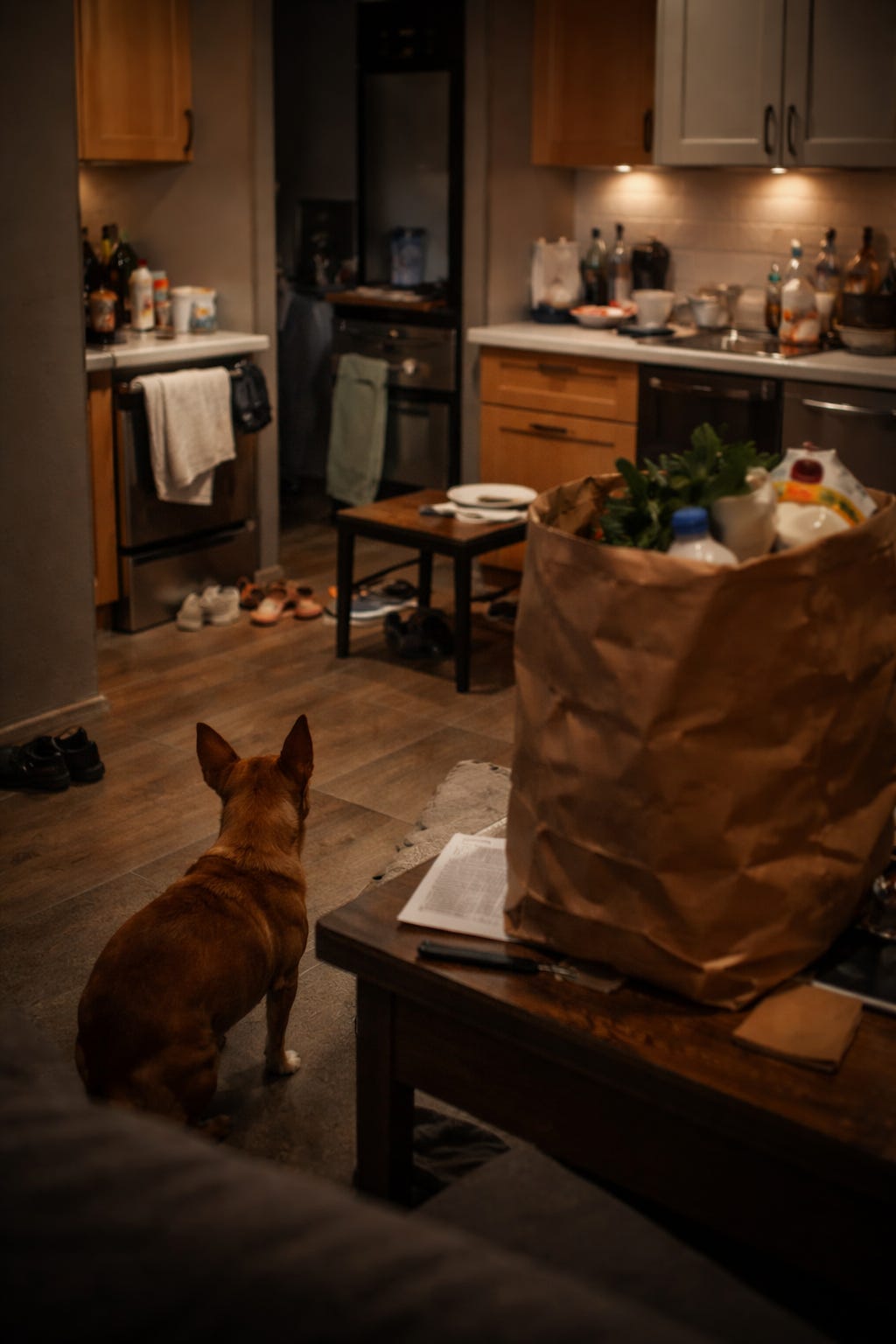
Boogs let out a low warning sound from somewhere deep in his chest.
Don’t.
Kevin stood there a moment longer, then took the phone from his pocket and put it in the junk drawer beside the batteries and expired coupons. Boogs watched until the drawer shut. Then he turned, padded to the groceries, and lifted one leg against the paper bag with slow, ceremonial disdain.
Kevin laughed despite himself.
That night, at least, the machine could go hungry.